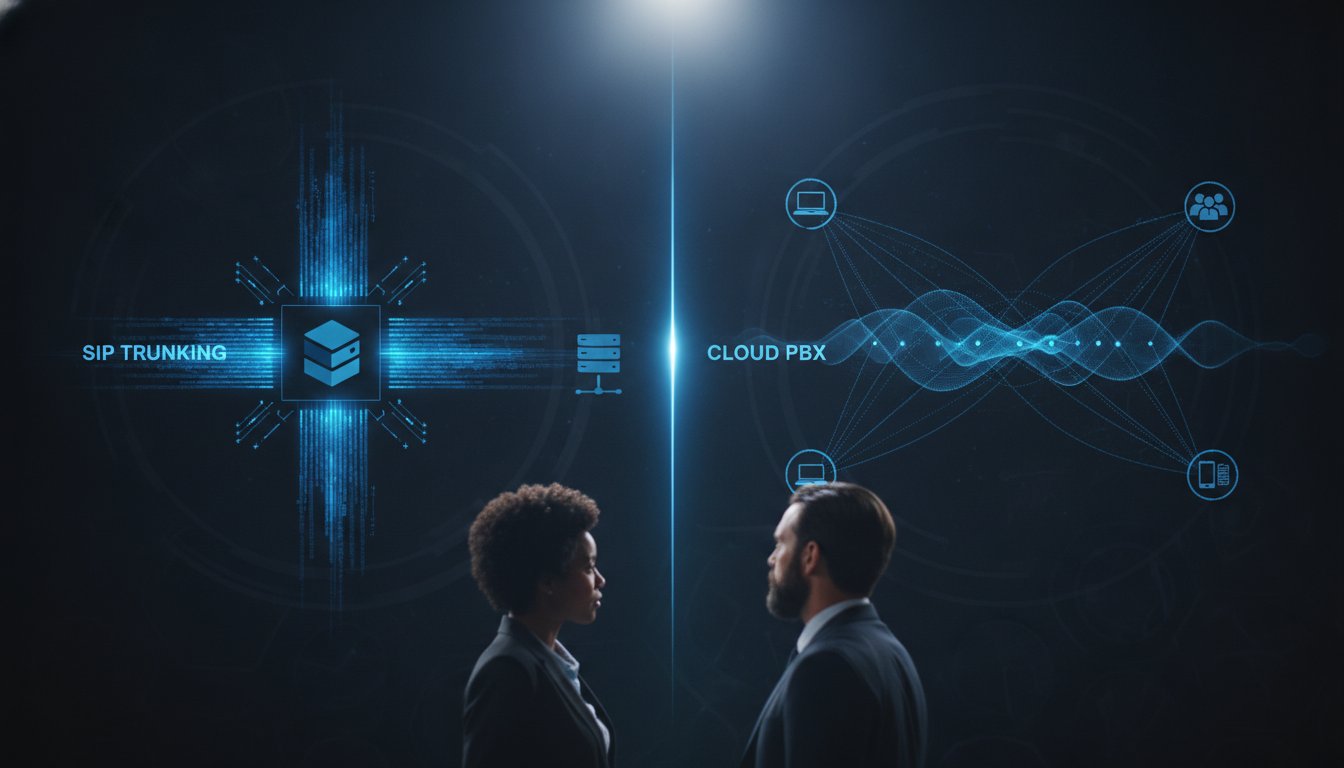
The global VoIP market is projected to reach $195 billion this year as American enterprises aggressively phase out legacy infrastructure in favor of digital agility. You’ve likely felt the strain of high maintenance costs for aging hardware and the struggle to scale operations during peak sales seasons. It’s a common frustration when fragmented communication tools don’t talk to your CRM, forcing your team to manage data silos instead of closing verified opportunities.
This guide explores the critical differences of sip trunking vs cloud pbx to determine which infrastructure best supports your business scalability and AI-driven outreach goals. Transitioning to a modern setup can reduce operational costs by up to 65% while enabling seamless integration with AI powered dialers. We’ll preview the shift from traditional capital expenditures to flexible cloud models and show you how to build a unified sales engine that empowers your remote teams for market dominance.
The telecommunications landscape is undergoing a massive transformation. The global shift away from traditional Public Switched Telephone Networks (PSTN) has accelerated, making legacy hardware increasingly obsolete. By 2026, the distinction between sip trunking vs cloud pbx has become the cornerstone of enterprise agility. This isn’t merely a change in hardware; it’s a fundamental migration from rigid physical copper wires to dynamic, session-based IP protocols. Your choice here determines whether your infrastructure acts as a bottleneck or a catalyst for high-volume growth.
For organizational leaders, the decision impacts everything from technical cohesion to the delivery of verified opportunities. Understanding these technologies is no longer just for the IT department. It’s a strategic requirement for anyone looking to scale operations and leverage advanced computational logic in their sales outreach.
Traditional T1 and PRI lines are relics of a slower era. Session Initiation Protocol (SIP) has successfully replaced these physical connections with virtual pipes. These pipes carry voice, video, and data over a single internet connection, which maximizes bandwidth efficiency and reduces operational friction. The role of the trunk is to manage multiple concurrent calls through your existing internet connection rather than individual physical wires.
SIP trunking acts as the digital bridge between legacy hardware and modern VoIP. It allows organizations to retain their existing on-premise PBX systems while gaining the scalability and cost benefits of the cloud. This architecture is particularly vital for high-volume outreach centers where controlling every aspect of the call routing logic and security protocols is a competitive necessity. It offers a level of high-level customization that managed services often can’t match.
Cloud PBX represents the complete virtualization of the phone system. Instead of maintaining a server room filled with cooling units and tangled cables, businesses subscribe to a fully managed, software-based environment. This model is often categorized under Unified Communications as a Service (UCaaS). It integrates voice, messaging, and video into one fluid interface accessible from anywhere in the world.
The elimination of onsite hardware maintenance transforms communication from a heavy capital expenditure into a predictable operational expense. There’s no need for specialized technicians to manage physical servers. For global remote teams, this architecture provides immediate accessibility. It ensures that your sales engine remains operational without the logistical burden of local infrastructure. This shift allows your team to focus on proactive outreach rather than troubleshooting hardware failures.
Deciding between sip trunking vs cloud pbx in 2026 requires a clear view of your long-term roadmap. Organizations prioritizing market dominance often look for the solution that offers the most seamless integration with an AI powered dialer. Whether you choose to own the communication engine or subscribe to a managed service, the goal is to ensure your infrastructure supports the high-speed demands of modern business development.
SIP trunking isn’t just a technical configuration; it’s a strategic asset for organizations that demand total ownership of their communication architecture. In the persistent debate of sip trunking vs cloud pbx, the primary advantage of trunking is the ability to dictate every nuance of your call routing logic. You aren’t just a tenant on a shared platform. Instead, you’re the architect of a dedicated engine designed for market dominance.
High-volume sales environments thrive on this level of granularity. By leveraging existing hardware investments, you avoid the costly “rip and replace” cycle, instead upgrading to VoIP benefits while maintaining specialized onsite configurations. This ownership allows for several critical operational advantages:
Modern outbound campaigns require more than simple dial tones. They demand deep integration with AI dialer software to process massive lead lists with surgical precision. SIP trunking provides the raw connectivity needed to fuel these automated systems while preserving legacy features that managed cloud providers often overlook. Crucially, managing your own trunk allows for superior control over local caller ID and answering machine detection. These tools are essential for ensuring your proactive outreach feels natural and results in a high-volume delivery of verified opportunities.
For industries like finance and healthcare, data sovereignty is a non-negotiable requirement. SIP trunking keeps your internal call data behind your own firewall, ensuring that sensitive information never traverses a third-party managed platform. This architecture makes it easier to meet strict industry regulations like HIPAA or PCI-DSS because you maintain absolute oversight of the network path. You can implement custom encryption layers, such as SRTP or TLS, tailored to your specific risk profile. This level of technical cohesion ensures your digital service remains a secure fortress while you scale.
If you’re ready to see how this level of control can transform your sales engine into a primary strategic asset, you can book a strategic walkthrough of our infrastructure solutions.
Agility is the primary currency of the modern enterprise. While SIP trunking provides deep architectural control, Cloud PBX offers immediate operational relief by removing the friction of hardware management. In the strategic evaluation of sip trunking vs cloud pbx, the cloud model stands out for its ability to transform a complex communication stack into a fluid, managed service. You don’t need to wait weeks for hardware shipments or onsite installations. Instead, you can deploy a national office network in minutes, ensuring your team is ready for action without technical delays.
This software-based approach significantly lowers the barrier to entry for advanced communication features. Scaling firms gain access to the same high-level tools used by Fortune 500 corporations without the heavy upfront investment. Reliability is reinforced through automatic updates. Your provider manages all security patches and software upgrades in the background, ensuring your system always utilizes the latest defenses against emerging threats. Built-in disaster recovery and geographic redundancy across multiple US data centers mean your sales engine remains operational even during local network failures.
A distributed workforce requires a communication hub that isn’t tethered to a physical server room. Cloud PBX connects your team through mobile apps and web-based softphones, providing a consistent user experience regardless of an employee’s physical location. This fluidity ensures that all team members, whether working remotely or in a central office, enjoy consistent technical capabilities. To explore how this architecture supports high-growth outreach, read our complete guide to Cloud PBX for deep implementation strategies.
One of the most compelling reasons to choose a managed platform in the sip trunking vs cloud pbx debate is the immediate access to enterprise-grade functionality. Features like intelligent call queuing, auto-attendants, and sophisticated analytics come standard. These tools move beyond simple voice calls, allowing you to orchestrate the entire customer journey with precision.
The true power of this environment emerges through seamless CRM integration. By syncing your phone system with your data processing tools, you transform a basic communication channel into a unified sales engine. This integration delivers real-time data reporting and automated lead tracking, which drastically reduces the burden on your internal IT staff. Your technical experts can pivot away from troubleshooting telephony software and focus on higher-level strategic initiatives that drive market dominance.
Selecting the right infrastructure requires a cold-eyed analysis of your operational priorities. In the 2026 landscape, the choice of sip trunking vs cloud pbx isn’t just about voice quality; it’s about how your technical stack handles the pressure of high-volume growth. Performance benchmarks reveal that latency and jitter are manageable in both environments, but the method of mitigation differs. SIP trunking allows for granular traffic shaping within your own network, while Cloud PBX relies on the provider’s global points of presence and robust Service Level Agreements (SLAs) that typically guarantee 99.99% uptime.
Scalability remains a primary differentiator. If you need to add 50 new agents during a peak seasonal sales surge, a cloud-based interface allows for instant provisioning with a few clicks. A hardware-dependent SIP setup might require additional line cards or server upgrades, which introduces a delay in your market response. Reliability is another critical factor. When a call fails at 2:00 AM, a Cloud PBX provider is responsible for the resolution. With an on-premise system connected via SIP, the burden of troubleshooting falls squarely on your internal team.
The financial debate centers on the transition from Capital Expenditure (CAPEX) to Operational Expenditure (OPEX). Cloud PBX operates on a predictable cost-per-user model, which simplifies budgeting as your headcount fluctuates. In contrast, SIP trunking often uses bulk-channel pricing, which can be more economical for massive outbound teams but requires a significant upfront investment in servers and gateways. You must also account for the technical debt of maintaining on-premise hardware, including electricity, cooling, and physical security. Cloud solutions offer predictable monthly billing, while SIP trunking involves variable maintenance costs and hardware lifecycle management.
Your IT team’s bandwidth is a finite strategic resource. You have to decide if they should spend their hours managing a PBX or focusing on core product growth and digital transformation. Cloud PBX offers a set-it-and-forget-it convenience that frees up technical staff for higher-value initiatives. However, if your business development requires high-level customization of call routing or deep integration with proprietary legacy systems, the granular control of SIP trunking is indispensable. Evaluating the importance of provider-led support versus in-house expertise is the final step in ensuring your communication engine remains a competitive tool for market dominance.
Determining the best fit for your specific volume requirements is easier with expert guidance. You can schedule a technical consultation and demo to see these architectures in action.
Sales-centric enterprises often realize that the debate over sip trunking vs cloud pbx isn’t a winner-take-all scenario. To achieve market dominance, high-growth firms frequently adopt a hybrid architecture. This approach leverages the raw power of SIP trunking for high-volume automated dialers while maintaining the agility of Cloud PBX for their global administrative and support teams. Nexdial bridges this gap by offering a unified infrastructure that supports the intense demands of modern lead generation without compromising on technical cohesion.
The goal of any telecommunications strategy is the high-volume delivery of verified opportunities. By integrating AI in sales, you move beyond the limitations of simple voice calls. Intelligent systems can now handle the heavy lifting of initial lead engagement, ensuring your human agents only speak with prospects who are ready to convert. This level of technical sophistication transforms your outreach from a mechanical process into a dynamic strategic instrument that fuels consistent growth.
Traditional PBX environments often buckle under the high-concurrency requirements of predictive and power dialers. These legacy systems weren’t designed to initiate hundreds of calls simultaneously or manage the complex logic of automated lead qualification. Nexdial’s AI powered dialer software is built to thrive in this high-pressure environment. Our technology conducts human-like conversations that feel organic and personal, effectively prequalifying leads before they ever reach your sales floor. This ensures that the user journey becomes a primary strategic asset rather than a series of disconnected touchpoints.
Choosing Nexdial means you don’t have to sacrifice granular control for cloud flexibility in the sip trunking vs cloud pbx decision. Our platform combines the robust security and routing customization of SIP with the zero-maintenance ease of a managed cloud contact center. We enhance your outreach with tools like local caller ID and answering machine detection to significantly boost response rates across different regions. This unified approach ensures that your technical infrastructure is perfectly aligned with your growth objectives and resource plenty.
Your communication stack shouldn’t be a limitation; it should be the engine that drives your market dominance. By aligning your hardware logic with intelligent execution, you create a seamless path for global expansion and technical reliability. Experience the future of sales-Book your Nexdial demo today.
The strategic choice of sip trunking vs cloud pbx determines the long-term agility of your sales engine. Organizations that require total ownership of their routing logic and security protocols find their strength in SIP trunking. Teams that prioritize rapid global expansion and zero-maintenance overhead achieve their goals through the managed environment of a Cloud PBX. Success in the modern market requires an infrastructure that doesn’t just connect calls but serves as a primary strategic instrument for growth.
Nexdial provides the technical cohesion needed to bridge these two worlds. By aligning robust infrastructure with intelligent execution, you ensure your team focuses on high-level customization rather than troubleshooting hardware. This approach is built for market dominance; it transforms every interaction into a verified opportunity through advanced computational logic. You don’t have to choose between control and convenience when you have a partner that understands the nuances of proactive outreach.
Ready to modernize your tech stack? Scale your sales engine with a personalized Nexdial demo to experience the benefits of AI-powered lead qualification and seamless CRM integration. This unified approach guarantees the high-volume delivery of verified opportunities while supporting your most ambitious expansion goals. Your path to professional dominance starts with a communication engine that is as forward-thinking as your business strategy.
SIP trunking is typically more expensive for small businesses initially because it requires an upfront investment in an on-premise PBX system. Cloud PBX follows a predictable per-user subscription model, which eliminates heavy capital expenditure. While SIP trunking becomes more cost-effective as seat counts and call volumes grow into the thousands, small teams usually find the operational expense of cloud solutions much more accessible for their budget.
Most modern IP phones are fully compatible with Cloud PBX systems if they support the standard Session Initiation Protocol. You might need to update the firmware or adjust the configuration settings to point to your new provider’s server. This allows you to protect your current hardware investment while still transitioning to a more fluid, software-based communication environment that supports global remote work.
Both solutions deliver high-definition voice quality, but SIP trunking offers more granular control over your internal network’s traffic shaping. In the sip trunking vs cloud pbx comparison, clarity depends heavily on your local internet bandwidth and router settings. SIP allows your IT team to prioritize voice packets at the hardware level, which can reduce jitter in high-volume environments where data usage is intense.
You don’t need a proprietary connection, but a high-speed, business-grade fiber line is essential for maintaining professional reliability. It is vital to have sufficient upload bandwidth to handle your maximum number of concurrent calls without latency. Many organizations implement a dedicated VLAN to separate voice traffic from standard office data, ensuring that large file transfers don’t interfere with your person-centric communication.
Yes, many enterprises deploy a hybrid model to achieve technical cohesion across different departments. You can use SIP trunking to fuel a high-volume AI powered dialer at your central hub while providing Cloud PBX licenses to remote agents and satellite offices. This approach allows you to maintain deep architectural control where it is needed most while enjoying the rapid scalability of the cloud for your distributed workforce.
Most modern systems include automatic failover protocols to ensure your sales engine stays operational. In a Cloud PBX setup, calls are instantly rerouted to mobile applications or external landlines. For SIP trunking, your provider can redirect incoming traffic to a secondary data center or a backup PSTN line. This redundancy ensures you continue receiving verified opportunities even during a local network failure.
SIP trunking provides the high-concurrency virtual pipes necessary for sip trunking vs cloud pbx architectures to handle massive outbound campaigns. It allows AI dialer software to initiate hundreds of simultaneous sessions with minimal latency. This robust infrastructure is a primary strategic asset for organizations that require the high-volume delivery of verified opportunities through automated, human-like conversations and intelligent lead qualification.
Enterprise-grade Cloud PBX platforms utilize advanced encryption protocols like TLS and SRTP to protect every interaction. These managed systems receive constant security patches to defend against emerging threats and often comply with strict regulations like HIPAA or PCI-DSS. While SIP trunking allows for localized firewall control, cloud solutions provide professional reassurance through geographic redundancy and expert-led security monitoring that smaller IT teams might struggle to replicate.
© 2019 - 2026 Nexdial, Inc. | All right reserved